I wrote this article for a Website in which I was asked to design a specific plan for an aspiring Olympic triathlete. A fellow coach was asked to do the same.
I now use these as teaching case-studies to juxtapose two very contrasting styles of coaching. Which style do you think is best?
Performance Plan for an Aspiring Olympian
A young, ambitious triathlete with limited race experience reaches out to Coach Andy Kirkland for help in making it to the Olympic Games in 2024.
Dr. Kirkland,
I’m writing you because I’d like you to coach me. I follow you on social media and like what you say about training. My goal is to be on the U.S. Olympic team for triathlon in 2024. I know this is a very high goal, but I think I can do it with your help. I’ll tell you why.
I graduated from the University of Colorado last year with a bachelor’s degree in exercise science. In college I ran track and cross-country all four years. On the track I ran the 5000m and 10,000m. My best 10,000m time was 28:03 when I placed in the top 5 at our conference meet. In high school I ran track in the spring and was on the swim team in the fall season. I was the conference champion in two swim events my senior year—the 100m and 200m freestyle.
After graduating I decided to do a triathlon. I borrowed a bike from a friend and won my age group. I’ve since gotten my own bike—not the best but good enough for amateur racing. I’ll soon have to find a sponsor, but there’s a bike shop that has expressed interest in helping me.
I’ve now done four Olympic-distance triathlons and won my age group in each of them. My fastest time was 1:52:30. With a better bike, more saddle time, and your coaching, I’m pretty certain I could go under 1:50. Because I’m pretty good at swimming and running already, the bulk of my training has been on the bike. I’m starting to show some improvement.
I’m highly motivated to race pro in the coming years. There won’t be much income at first, I know, but my parents, who are also triathletes, have promised to support me until I find sponsors. What I need most right now is a coach who can structure my training and guide me along the way. It will be a tough three years for both of us, but I feel certain I can pull it off.
What else do you need to know? I’m happy to provide whatever you need.
Thanks for considering working with me.
Randy Burton
Andy's Plan
Setting the goal of qualifying for the Olympics is a huge undertaking, and it is reliant on the athlete’s belief that they can perform against the very best athletes in the world. Many athletes may have the genetic potential to succeed but only a few make it. Athletes who get there typically have an innate need to win and follow the necessary processes to make it a reality.
In Randy’s case, an initial inspection of his training and race data suggests that he has the genetic potential, which is a pre-requisite. However, to progress to goal attainment requires planning that goes far beyond setting an annual training plan. My work with Randy requires that I lay a foundation for a successful partnership and outline the performance milestones en route to Randy’s goal. We will map a strategy to get Randy to the Olympics after addressing these critical objectives.
1. Establish a partnership and shore up support
Stage 1 of my plan is always to develop trust and rapport with the athlete. While this takes time, it is vital that we have confidence in each other’s ability and that we get along. I also need to explore Randy’s understanding of what his goal will require of him. Randy hasn’t yet experienced the benefit of being supported by a USAT development program, so he has not competed in draft-legal triathlon, nor has he won a major age-group race. So, he will have to cover the majority of costs for Year 1 and Year 2. With international travel, medical expenses, equipment, and day-to-day living, these costs could be comparable to studying at an Ivy League college. His parents have agreed to support him, so I also arranged a meeting with them to ensure that they know what to expect. Family support can be decisive in achieving performance goals, so I feel it’s important to include them in the planning processes.
2. Identify the Milestones Leading to the Goal
Stage 2 involves outlining what performance outcomes Randy will need to achieve to compete at the Olympics. Qualifying requirements sometimes change between Olympic cycles. However, Randy will likely need to finish top-8 in a qualifying World Triathlon Championship Series event and be ranked in the top 3 athletes in the U.S. in Year 3. To do this, Randy will need to achieve an elite race license and USAT-tiered funding relatively quickly. He will also have to race abroad and achieve consistently good results almost straightaway. Year 1 will require considerable upfront investment, and great results will help him achieve sponsorship.
3. Develop a Strategic Plan
Stage 3 of my plan is focused on helping Randy design a strategic plan. I approach this task much in the same way as a entrepreneur would prepare to pitch a business idea to investors.
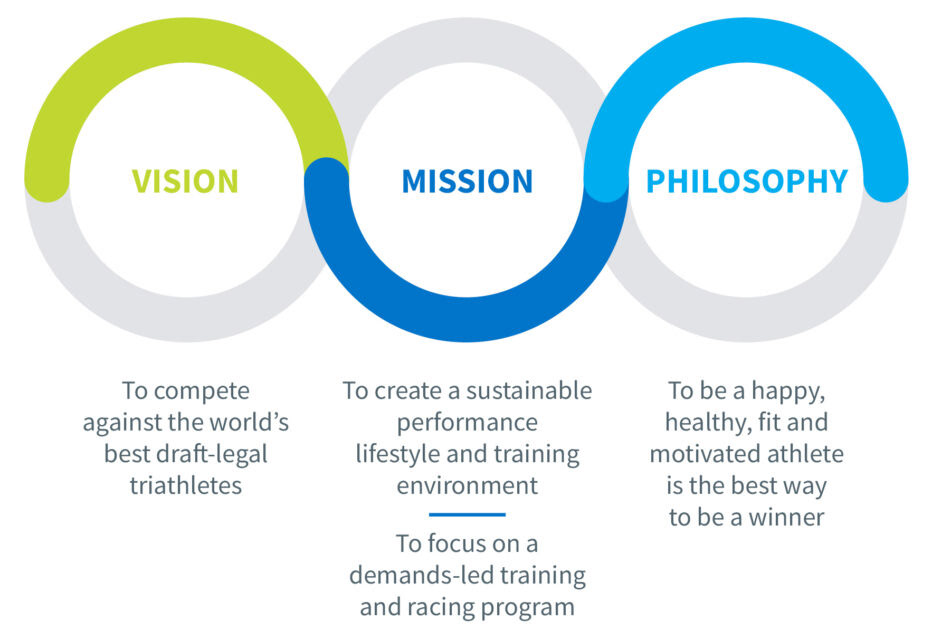
Within the strategic plan, Randy and I will come to agreement on the vision, mission, and philosophy that will shape his training. Part of the coach-athlete relationship involves helping athletes make the right decisions, and referring back to this strategic plan will be very helpful in this regard. My knowledge, values, and beliefs influence how I coach, and these must be consistent with Randy’s. He is very proud that he has trained hard and “mixed it up” with some of the best in Boulder, Colorado. From a coaching perspective, this concerns me a little.
One of my beliefs surrounding mental toughness is that athletes must be brave enough to stand out from the crowd, which typically means training with restraint and discipline. In reviewing Randy’s training diary from last year, I came to believe his bandwidth was likely too narrow and contained too many “smash it” workouts. Add in a regular schedule of traveling to races, particularly one that includes international travel, and an athlete like Randy can very quickly find himself fighting burnout.
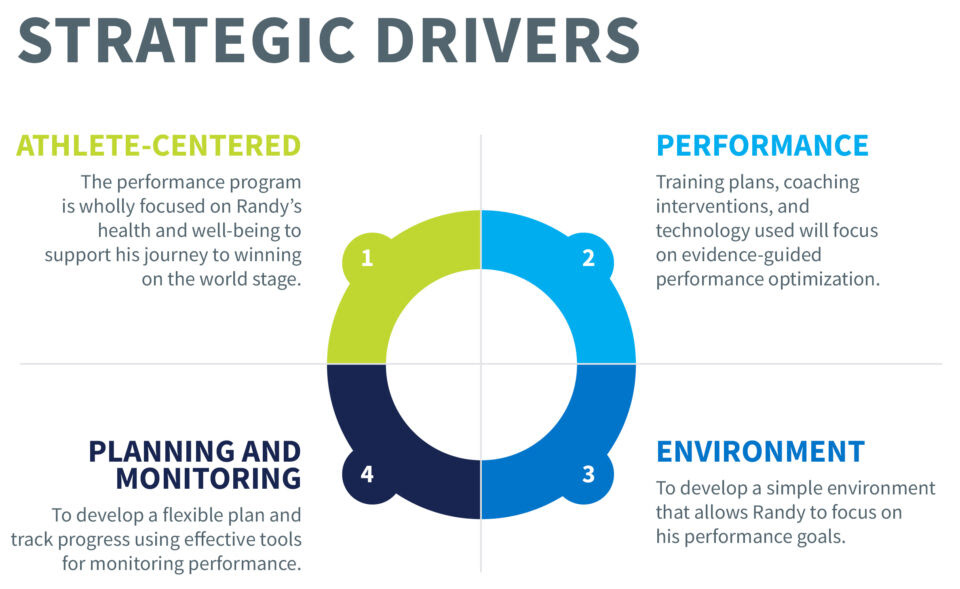
Randy and I came to agree on four strategic drivers with the performance program and design. These points are fundamental to how I coach and part of the expertise I have in sport. I don’t adhere to any particular coaching methods or approaches. Rather, I consider myself a “chameleon coach.” I am committed to developing custom performance programs that go beyond managing training loads and prescribing sessions. These strategic drivers explain the “why” of what I ask athletes to do and avoid the B.S. that’s often associated with performance sport.
Designing the 3-year macrocycle
When planning for a 4-year Olympic cycle, an annual plan effectively functions as a mesocycle. It must be aligned to the bigger plan—in this case, a 3-year macrocycle. Randy must deliver on several pre-requisite, performance-related factors each year in order to qualify for the Olympics, outlined here:
Year 1
• Finish Top 3 in elite development race
• Achieve USAT elite license
• Compete in a draft-legal event
Year 2
• Win at ITU Continental Cup level
• Race in ITU WTC series event
• Achieving USAT Team Selection
Year 3
• Achieve Top 10 in ITU WTC series events
• Gain selection at Olympic qualifier
• Race at the Olympic Games
By talking through what is involved in the macrocycle, Randy will better understand what he needs to do to succeed.
Annual Plan for Year 1
Many traditional ways to design annual training plans are based on flawed assumptions, specifically that physiological adaptation is predictable and linear. Rather, training adaptations are dependent on the complex interaction between physiological factors, mental factors, and the social environment in which the athlete lives and trains. Randy lives in Boulder, at altitude, with great facilities. But Boulder is also a pressure cooker filled with talented athletes, which can be stressful for many athletes. This model from John Kiely (a senior lecturer in elite performance) illustrates the factors that influence training adaptation, and I always consider them when building a program:
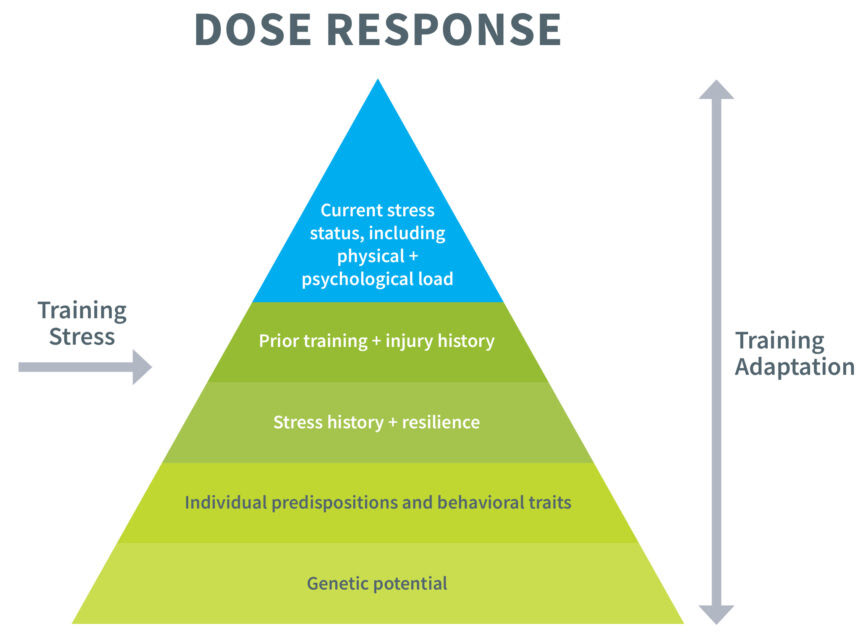
Because of these factors, I will design a very basic annual plan with key races and performance benchmark dates that the athlete and I agree on.
I also have a ”What It Takes to Win” spreadsheet that allows me to break down all performance demands of racing and the other demands of living a performance lifestyle. The spreadsheet will include columns for specific race paces and power-profiling. It will also have a wide array of technical, tactical, and psychological factors, as well as more tangential (yet important) things like having a sustainable income. I don’t use this spreadsheet as a prescriptive tool, but rather as a guide to help the athlete decide short- and medium-term training priorities.
Like many coaches, from there I will usually plan training on a seven-day rolling basis using an iterative training model. I have a few ideas on how I’d like to approach the first phase of training. I hope to keep Randy engaged, improve his muscular endurance and power on the bike, and begin to address any obvious gaps in his training and physiology.
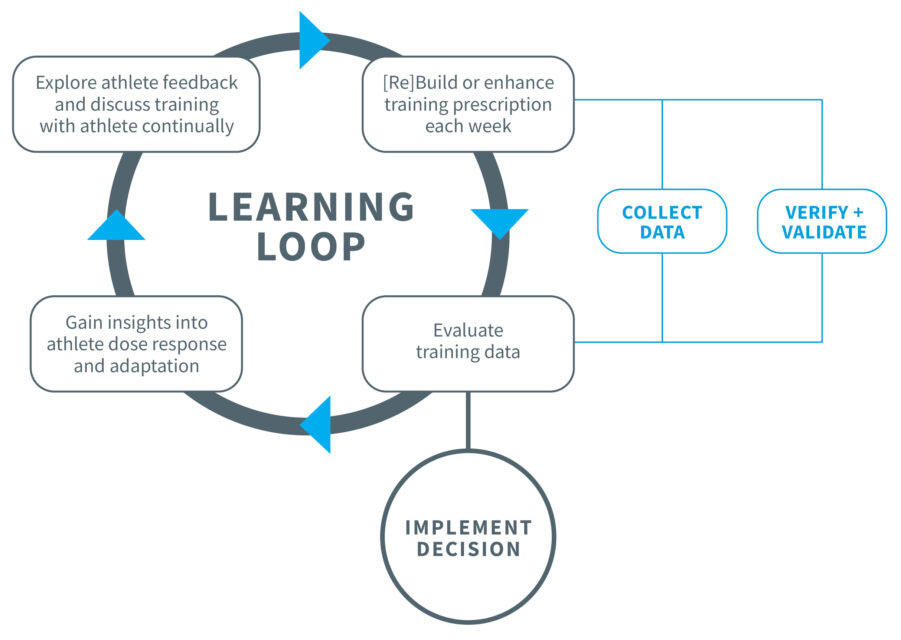
While I think Randy has too often focused on smashing his group workouts, I will prioritize group training sessions at times. It’s important for athletes to interact with others of a similar ability and to continue to enjoy training. It is also important to ensure athletes train in a variety of different environments. Triathletes in particular need to regularly swim in open water. Racing on the international circuit demands an ability to cope with a wide range of conditions and courses, and this preparation needs to be accounted for in the plan. Implementation of this type of preparation does not always fit a “tidy” training program.
Build power for short-course racing
Randy’s training data indicates that he has trained more like a 70.3- or 140.6-distance athlete at steady-state intensities. This held true in his hard group rides. However, a draft-legal athlete must be able to race in a group. In a one-hour bike leg this means accelerating out of corners at power outputs greater than 600W, as much as 50–60 times.
Last season Randy was also doing just one weekly strength session, and without supervision. One of the first things I will do is to arrange a dynamic movement screening with a physiotherapist. Next I will find a good strength and conditioning coach to optimize his training for the specific demands of racing.
I arranged for Randy to race a Crit City Criterium on Zwift as an early “benchmark” session. This was positive in one regard—he averaged over 300W but he struggled to hit over 500W in the second half of the race. This tells me that the priority is to work on his efforts of one-minute or less.
Observe athlete preference in training
Early on, I often invite athletes to choose how they want to train in some workouts. Athletes will typically do the sessions that they most enjoy. If they gravitate toward harder sessions (which I expect Randy to do), it tells me that we need to work on endurance. Again, there’s a tremendous degree of mental toughness involved in triathlon. I don’t talk about it in this way with athletes because they equate mental toughness with pushing hard. It’s equally important to be able to go easy. For example, I am curious about whether Randy can run over 8-minute miles. Doing so will undoubtedly seem inefficient and cause his legs to feel heavy. This is why athletes tend to change the feeling of these easy sessions, but getting the legs to feel good in easy sessions can really lift to performance later in the season.
Once we are a few months into the season, it’s my hope that Randy will become more comfortable with my coaching methodology and the trust will continue to build from there.
End
Season Plan for Triathlete Leveling Up to Ironman
Mary is in search of building a big aerobic fitness base for ironman-distance racing. Ultimately, she has wants to qualify for Kona and she believes Alan Couzens is the coach who can help her make that dream a reality.
Hi Alan,
I follow you on Twitter and like your views on training. I’m also a fan of building a big aerobic fitness base. That’s worked pretty well for me. So it’s good to read your thoughts on why.
I’m reaching out to you because I think I need a coach. I’ve never had one in six years of doing triathlons. For the last several of those years I’ve mainly focused on half-Ironman races. And I’ve gotten faster just by doing mostly aerobic training in all three sports. But there are also hills where I live (San Diego), so I get a fair amount of climbing on the bike and also while running. I’ve been with a masters swim group for the past couple of years. Swimming is my weakest sport. I’m pretty good on the bike, and running is my strong sport.
I’ve got a big goal for next year. I’d like to do my first full Ironman and qualify for Kona. I think I can do it because my 70.3 times have been getting steadily better over the last four years. I’ve gone from 6:15 for my first in 2017 (31st place) to 5:28 in 2019 (10th place). And I turn 40 at the end of this year so I’ll move into a new age group. My goal race is almost a year away—Sacramento in the fall of 2022. So I think I have a lot of time to get ready.
I’ve included a summary of my 70.3 races. I’ve also done sprint- and Olympic-distance triathlons and running races from 5K to half marathon since 2015. I didn’t do any racing in 2020 or 2021 due to Covid.
I’m anxious to get started again and really look forward to doing an Ironman and qualifying, especially with your help. Please let me know what else you need from me. I’d like to get started as soon as you think it’s the right time.
Thanks for considering coaching me.
Mary Monroe
Athletic summary for Mary Monroe
Age: 39
Vocation: Computer programmer
Work schedule: ~40 hours (8:30 a.m.–5 p.m., M–F)
Home: San Diego, CA
Sport: Triathlon racing since spring 2015. Perceived weakest event is the swim. Perceived strongest event is the run.
70.3 race results
• 2017: Oceanside, 6:15:00 (Swim 1:18:10, Bike 2:59:20, Run 1:40:30), 31st place 35-39
• 2018: Galveston, 5:48:10 (Swim 1:17:01, Bike 2:54:00, Run 1:37:09), 29th place 35-39
• 2018: Monterrey, 5:37:30 (Swim 1:17:05, Bike 2:49:15, Run 1:31:10), 20th place 35-39
2019: Oceanside, 5:28:37 (Swim 1:05:30, Bike 2:44:50, Run 1:38:17), 10th place 35-39
Additional Notes:
• Some Olympic and sprint triathlon races and 5K and half-marathon running races in 2015–2016.
• No races in 2020 or 2021 due to Covid. Base training continued.
• Self-coached in bike and run; masters swim group with coach on deck.
• Training has been mostly LSD (long, slow distance), hills, group workouts in bike and run with training volume mostly of 9-15 hours per week for all three sports.
Goal: Complete first Ironman (Sacramento) in 10 months to qualify for Kona in 2023.
Goal time: 11:35
Goal splits: Swim 2:20, Bike 5:45, Run 3:30
Upcoming birthday will move me into the women’s 40-44 age group next year.
Athletes often underestimate the amount of fitness that they lose in tapering for, and recovery from, excessively frequent racing. This is especially true in Mary’s case where she is looking to make a significant jump in training load in order to properly prepare for the Ironman distance.
The first thing that I always do is outline how much time we have to work with until the A-Race and then work back from there. In this case, Mary’s race is almost 12 months into the future, so we have a nice full annual cycle to work with. Frankly, it’s uncommon for athletes to come to me with this much lead time before a target event. More often than not, I find it is something that I am pushing for.
So, having the year to work with, how do we break it up? A good rule of thumb is to have the General Preparation (“Base”) phase longer than the Specific Preparation (“Build”) phases for developing athletes. Splitting our 52 weeks in half, I want at least 26 weeks devoted to the lead-in “Preparation” block coupled with the long “General Preparation” period.
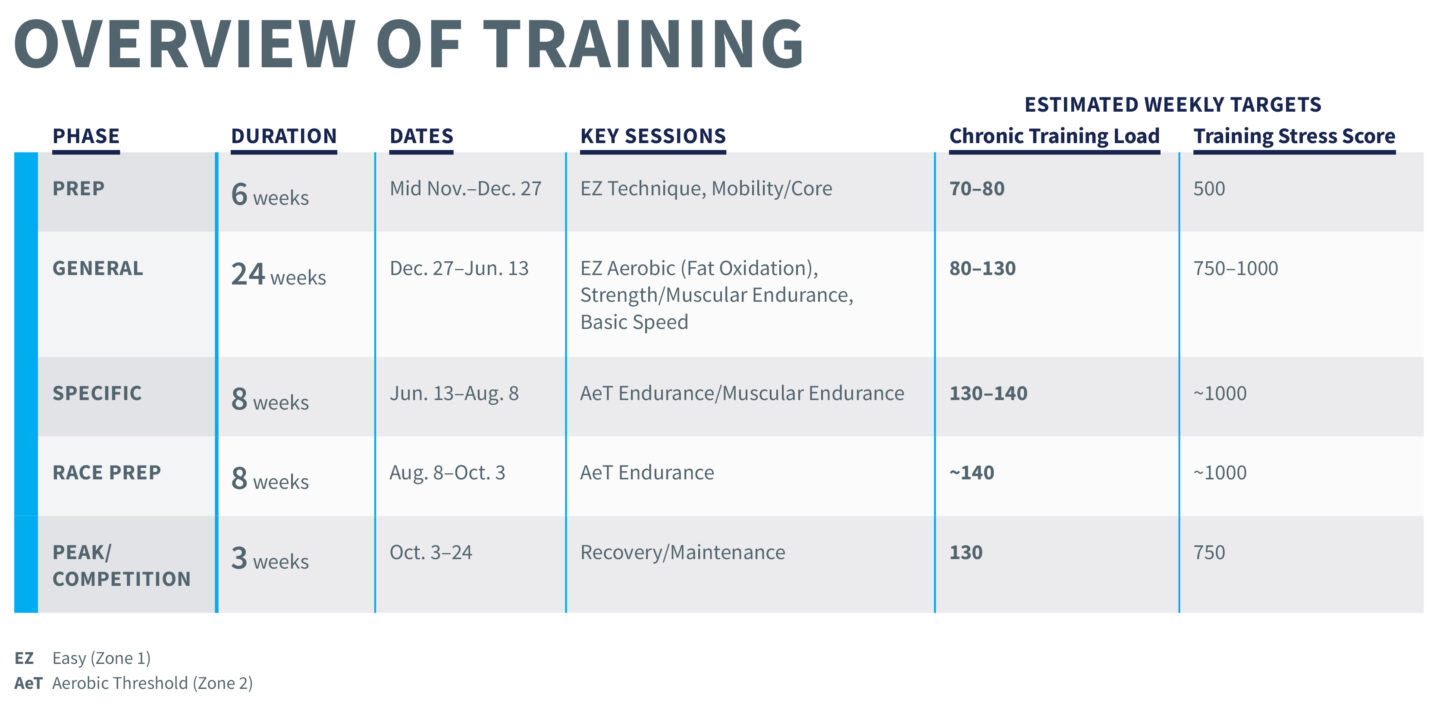
See Coach Couzens Training Terminology for more information on specific energy systems and the physiological markers being targeted.
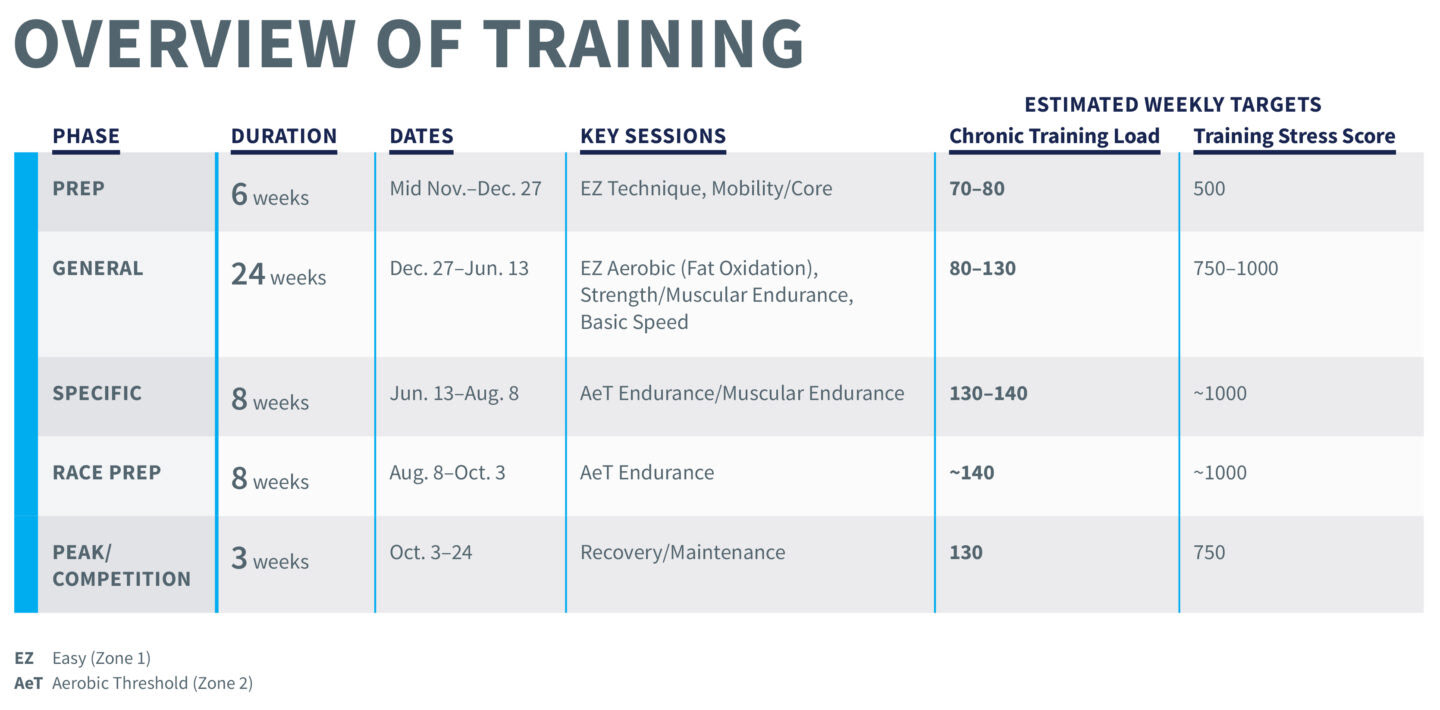
General Preparation Phase
Goal 1: Increase general fitness
My aim in the General Preparation period is to increase general fitness (i.e., fitness) that is independent of the distance or event that the athlete is competing in. In other words, this is not the phase where we focus on specificity of training. ALL athletes benefit from basic aerobic fitness, which leads to rich mitochondrial and capillary development in the slow-twitch fibers, a large cardiac volume, and an ability to utilize fat as a substrate and spare glycogen when not engaged in specific training. These qualities bring about two advantages for the athlete:
1. improved speed of recovery, which leads to
2. increased capacity for the sport-specific work, namely an improved reliance on aerobic metabolism, which spares limited fuels like glycogen and increases reliance on unlimited fat stores.
Goal 2: Strength and muscular development
Additionally, all athletes benefit from a baseline of strength and muscular development. In most sports, an athlete can reach a level where they have insufficient strength to utilize their available aerobic fitness. This is why it’s important to keep coming back to strength and muscular development throughout training—particularly for older athletes and females. This strength work doesn’t need to be limited to the gym. The late General Preparation phase is a great time to work on sport-specific muscular development. These sessions will focus on higher muscular loads—big gear
cycling, running hills, paddle work in the pool, etc.—while sticking to aerobic heart rates to give the aerobic muscle fibers a good strength stimulus.
Goal 3: Movement economy
Finally, the General Preparation period is a great time to work on movement economy. Most sessions will have a technical focus. Since the athlete is typically training without a lot of intensity,
more attention can be directed to the movements. While much of this work is slow and easy, a little “spice”—faster movement under low conditions of fatigue but with high movement quality—is technically beneficial. This work also serves as a good maintenance stimulus for those higher-threshold, fast glycolytic muscle fibers.
Given Mary’s relatively weak swim, this technical work will factor heavily in her time in the pool. The ability to swim well slowly is uncommon in triathletes. Only after Mary can swim well slowly will she be able to swim well at race speed. This will be our emphasis in this phase.
A key metric that we are tracking and looking to improve in this phase is the Efficiency Factor, i.e., how physically and technically efficient the athlete is in transferring each heart beat to forward movement.
Specific Preparation Phase
The objectives of the Specific Preparation phase are, unsurprisingly then, to tackle the abilities that are specific to the event that the athlete is preparing for. In Mary’s case, that will be specific endurance.
The phase is divided into Early Specific Prep and Late Specific Prep (or Race Prep) phases. The difference between these two blocks is that the Early Specific Prep is largely focused on gradually building specific endurance (increasing aerobic threshold) in each individual sport, while the late Specific Prep or Race Prep phase focuses on integrating the three disciplines into race-specific workouts and focusing on execution.
Extending AeT endurance to achieve Mary’s goal time of 11:35 will be a challenging task. She will need to gradually push out the duration of those key Zone 2 sets. While the General Prep phase will give Mary competitive AeT power numbers, the Specific Prep phase will ensure that she can hold those numbers for the duration of the event.
Race Preparation Phase
Once Mary’s specific endurance is established, the Race Preparation phase will put the proverbial icing on the cake by focusing on long-event, specific “simulations” coupled with recovery and maintenance of her other capacities. The Race Preparation phase is focused on practicing the physical, psychological, and tactical skills of the race. Emphasis is on the key sessions, with particular attention to the tactical aspects of racing well at an Ironman-distance event—notably, proper pacing and a proven nutrition/hydration plan.
• Metric Ironman: 2.4K swim/112K bike/26K run at target race pace
• 6-hour progressive ride: 2 hours easy, 2 hours at IM pace, 2 hours above IM pace
• 9-hour BIG day: Get as close to race duration as possible, but at a lower intensity and with less impact—a very long ride, a combination swim/ride/hike, etc. This is primarily a task in fueling and psychologically being “out there” for a very long time. (To reduce intensity, I recommend hiking as a great alternative to a long run on these days.)
Peak/Competition Phase
Finally, in the Peak/Comp phase, the emphasis will shift to stabilizing freshness prior to the race. The Race Prep phase was characterized by wide swings in the freshness of the athlete—from very challenging sessions that necessitated longer periods of recovery to multiple days of very easy work that brought the athlete back to a high level of freshness before hitting them again with a very challenging workout. In this phase the taper will seek to stabilize freshness as much as possible. We don’t necessarily want the athlete jumping out of their skin with energy; we want them to feel generally good and ideally a little better each day.
Load development
I asked Mary to give an estimate of her chronic and acute volume during my initial questions. I use that information to get a “ballpark” of starting CTL numbers. Mary reported that she has been
training consistently at 12–14 hours a week for the past 2 years. Because she has been recording her data for the past 2 years in TrainingPeaks, I could estimate her starting CTL more accurately.
12 hours per week averages to be 1.7 hours per day.
At a guesstimate of 50 TSS/hr., this would put her starting CTL in the 85 range (1.7 * 50).
The other thing that this comment about training consistently for the past 2 years tells me is that she may not have had a major unload during that time. So for the first 6 weeks, I will be OK seeing that CTL drop a little in exchange for some freshness. To do this, I will plan the initial 6 weeks with slightly under that 85 TSS/d—closer to 70/day or 500 TSS for the week. I will do this primarily through a conscious drop in intensity of the sessions, with more of a focus on technique.
Ramp rate for training
I also asked Mary to give me some information with regards to her overall health, life stress, and injury history. I use this information to help determine how initially aggressive I want to be with her ramp rates. Compared to a lot of athletes, Mary’s life sounds on the low-stress side. She also has no recent injury issues. Her sleep schedule is decent (10 p.m. – 5 a.m. = 7 hr. on Mon./Wed./Fri. and presumably more on the days that she doesn’t swim masters at 5:30 a.m.). But sleep is something that we can probably improve on by encouraging her to drop some of those early morning masters swims when tired. Nutrition doesn’t sound optimal, but she does sound like she is fueling the sessions well and we can work on adding a little more good protein throughout the day. Based on all of the above, I’d put Mary in the average category for load ramp. Low would be <5 CTL/month, average would be 5–10 CTL/month, and high would be 10–15 CTL/month. With 6 months of General Prep to work with, we should be able to put on ~50 CTL in that time (8 CTL/month x 6 months).
The above, of course, depends on Mary having sufficient space within her life/week to accommodate those key 1000 TSS (20+ hr.) weeks that will get her Chronic Load to that level without compromising recovery. To assess this, I tried to get a really good sense of what Mary’s days look like and what additional responsibilities she has. This is absolutely key in determining the maximal load that an athlete can handle. It is no good planning a 20-hour training week if the athlete has to sacrifice sleep in order to reach it.
While it’s good to have a general guideline, all of the above is completely hypothetical. I will use Mary’s Heart Rate Variability and wellness scores to determine how much load and, more specifically, how many loading sessions I give her on a weekly basis. For example, if Mary’s CTL is 100 in the late General Prep phase and her HRV/wellness metrics are looking good, I might plan a loading day of 130 TSS with a key muscular endurance set on the bike. If she is at the same CTL but her HRV is in the toilet, I might plan a recovery day of only 70 TSS with a low muscular load (high cadence) and a firm heart rate cap at her Aerobic Threshold. An average of 3 loading days and 1 long day per week coupled with 3 recovery days will keep us on track for our 8 CTL/month goal. However, if Mary has periods where her HRV and wellness metrics are low for 5 days of the week rather than the guesstimate of 3, I will defer to what her body is telling us for that week and let the ramp rate slide as needed.
If we’re able to keep recovery in a good spot, we should arrive out of the General Prep phase with a significantly elevated aerobic fitness (Efficiency Factor numbers, significantly improved efficiency especially in the water) and a CTL in the 130 range, a number that puts a good, strong Ironman performance within reach. Importantly, a key principle that I try to follow is not to raise both volume and intensity at the same time. While General Prep is the time for building the training load through increased volume, in Specific Prep we will focus more on the intensity side of the equation (primarily through increasing the percentage of Z2 work in the week). Because of this, the ramp in CTL will be significantly slower as we have more recovery days in the week between the very tough key workouts.For example, after a 6-hour, ~300 TSS Z2 workout, we expect to see a few days with low readiness metrics. For this reason, I only project half the CTL ramp of the General Prep phase—only 4 CTL per month. And, to be frank, if no ramp occurs during this time but the athlete maintains CTL while pushing out her AeT endurance in those key workouts to approach race duration, I will be 100% OK with that. The focus in Specific Prep is, first and foremost, on those key workouts.
Fit, fresh, and race-ready
Finally, in the Peak/Comp phase, the emphasis will shift to stabilizing freshness prior to the race. We will happily give up some CTL to do this. Stable + Fresh + Fit + Proven AeT endurance is what we want to rock up to the start line with. In this phase, we will keep the same routine as the Race Prep phase, but sessions will reduce in volume. Our number one goal is stability—of HRV, energy, and generally feeling good each day. To do this, we’ll keep the engine ticking over but ensure we only add just enough fatigue to keep the body (and the mind) remembering what it does as an athlete. While the training content, intensity, and frequency will remain similar to the Race Prep phase, we will increase Training Stress Balance (TSB) to a positive number during this phase—on average, in the range of +20. We will do this by reducing the daily load below Mary’s CTL (~140 TSS/day) to an average of only ~110/day (~750 TSS/week).
Coach’s Note: While Mary’s season plan might come across as quite definitive and quantitative, in practice, I take Eisenhower’s viewpoint: “While plans are useless, planning is indispensable.” Things will crop up over the course of the year that alter the plan—both life stuff and things that we learn about the athlete. For example, maybe we find out that Mary is greatly limited by her muscular development and so we place more attention on that during the key workouts of the base phase. Maybe we learn that Mary’s job is actually far more stressful than she is letting on and she demands a more gentle ramp than initially thought, etc. This attentiveness and flexibility is the art of coaching. That said, hopefully the above offers some insight into my general thought process when it comes to deciding what to program for a given athlete.